Audio guide in English: The Imperial Period
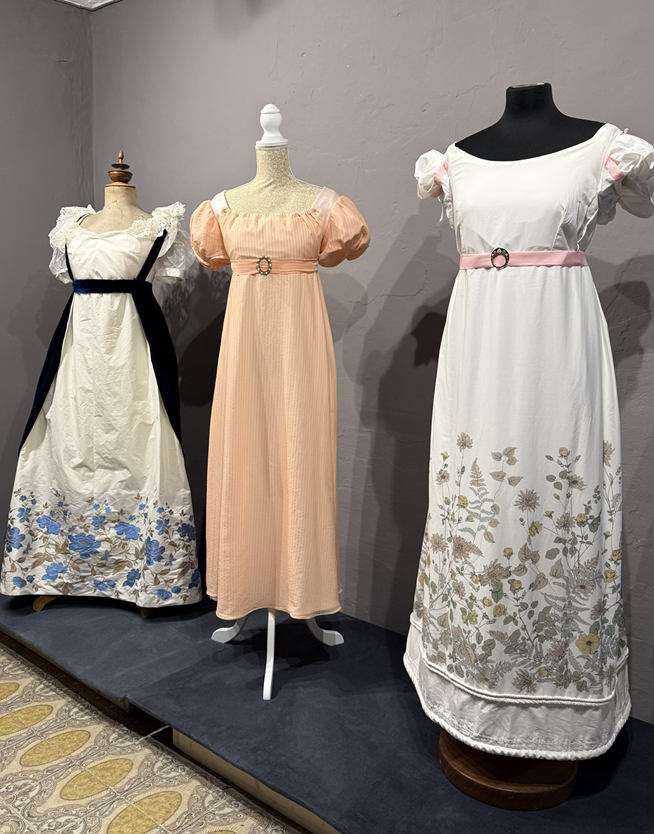

The Empire period, spanning the late 18th and early 19th centuries, emerged in the wake of profound political and cultural transformation in Europe, most notably following the French Revolution. As old aristocratic structures gave way to new ideals, fashion underwent a radical shift. The heavy ornamentation and rigid silhouettes of earlier periods were replaced by a style that embraced simplicity, natural form, and a renewed admiration for classical antiquity.
Inspired by the aesthetics of ancient Greece and Rome, the Empire style sought to reflect purity, harmony, and proportion. This influence is most clearly seen in the defining feature of the period: the high waistline, positioned just below the bust. From this elevated line, the fabric falls freely in soft, vertical folds, creating a long, fluid silhouette that emphasizes grace rather than structure.
Empire dresses are often recognized for their lightness—both visually and physically. Unlike the elaborate constructions of the Baroque or Rococo periods, these garments required minimal internal support. Corsetry, while not entirely abandoned, was significantly softened, allowing for a more natural body shape. The skirt, typically unstructured, flowed gently to the floor, sometimes with a slight train for formal occasions.
The choice of materials played a crucial role in achieving this effect. Fine, lightweight fabrics such as muslin, cotton, silk, and fine linen were preferred. Among these, white muslin became particularly iconic, symbolizing both classical ideals and a certain democratic simplicity that resonated with the spirit of the age. These fabrics allowed the garment to move naturally with the body, enhancing the sense of effortless elegance.
Color palettes were often restrained, especially in the early years of the period. White and soft pastels dominated, though richer tones and subtle decorative elements became more common as the style evolved, particularly during the reign of Napoleon Bonaparte, when imperial symbolism began to reintroduce a sense of grandeur.
Despite their apparent simplicity, Empire dresses were the result of refined craftsmanship. The construction emphasized precise cutting and careful draping rather than heavy structuring. Seams were often placed to enhance verticality, elongating the figure. Hand-stitching remained the primary technique, with attention given to delicate finishes and hidden construction details.
Decoration, when present, was subtle and strategically placed. Embroidery, fine pleating, lace trims, and narrow ribbons were commonly used to accent the neckline, sleeves, or hem. Short, puffed sleeves were typical, leaving the arms and neckline more exposed than in previous eras—another nod to classical inspiration.
The Empire period represents a unique moment in the history of fashion—a balance between restraint and refinement, where elegance was achieved not through excess, but through proportion, material, and movement. It is a style that continues to influence modern interpretations of formal and bridal wear, reminding us that true sophistication often lies in simplicity.
In the context of historical reconstruction, Empire garments demand a deep understanding of both technique and philosophy. Their apparent minimalism leaves no room for inaccuracy: every line, every fold, and every choice of fabric must align with the principles of the time. It is precisely this quiet precision that makes the Empire dress one of the most challenging—and rewarding—forms to recreate authentically.
 House of Historical Clothing